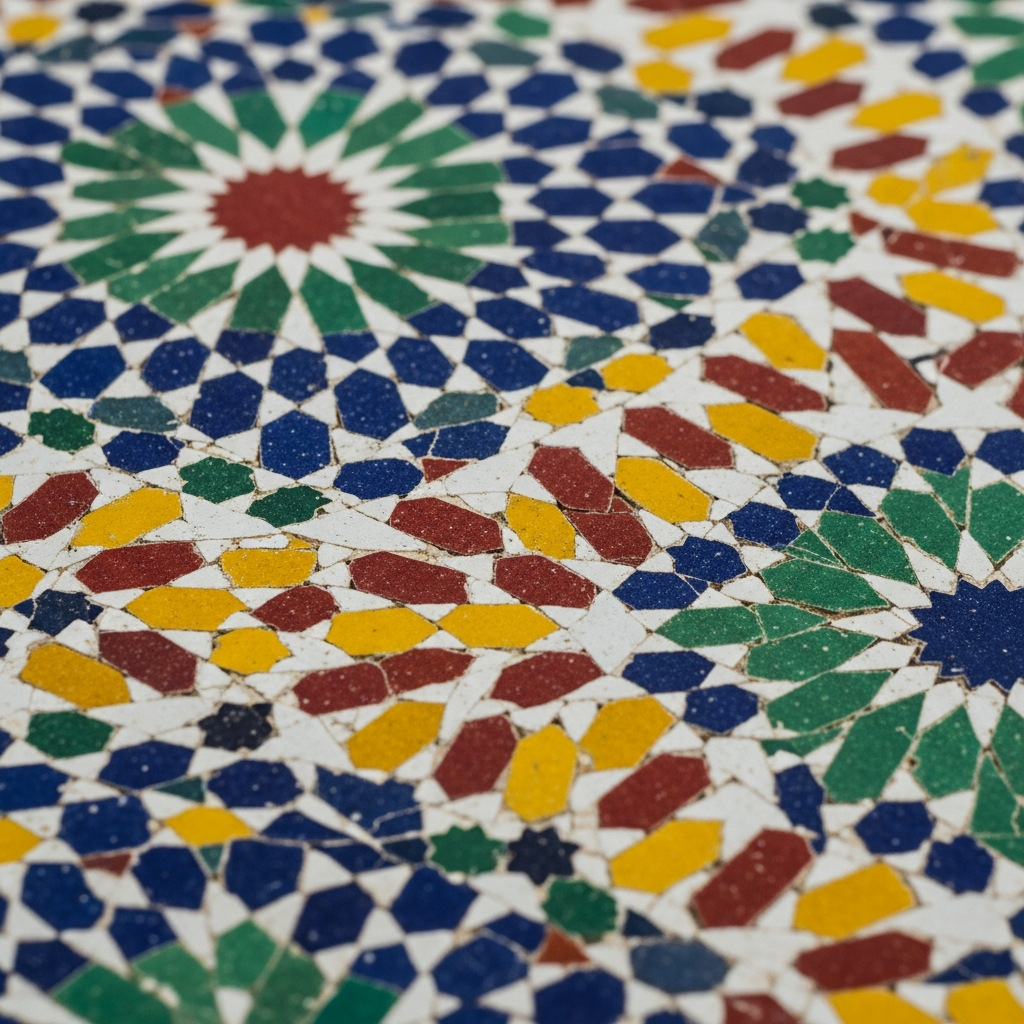
Zellige is the exquisite terra cotta tilework covered with enamel, manually chipped and set into plaster to create intricate geometric mosaics, representing the pinnacle of Moroccan craftsmanship.
Zellige is one of the most distinctive and admired forms of Moroccan art. It consists of individually hand-chiseled geometric tiles set into a plaster base. This art form flourished during the Marinid dynasty (13th-15th century) and remains a hallmark of Moroccan architecture, adorning fountains, walls, floors, and pillars.
The creation of Zellige is a mastercraft that requires years of training. Maâlems (master craftsmen) memorize complex geometric patterns that are based on strict mathematical principles of symmetry and tessellation. The process begins with clay from the Fez region, which is glazed, fired, and then painstakingly cut into specific shapes (furmah) using a heavy hammer-sharpener (menqach).
Beyond its aesthetic beauty, Zellige carries deep spiritual significance. The infinite geometric patterns are often seen as a representation of the infinite nature of God and the order of the universe. Today, Zellige is celebrated globally as a symbol of Moroccan identity and sophisticated design.