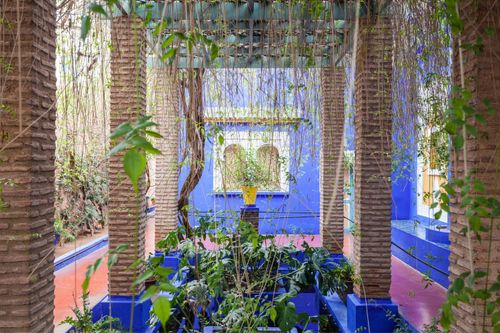
From his first visit in 1966 to the scattering of his ashes there in 2008, Marrakech — and the Jardin Majorelle he saved with Pierre Bergé — was the lifelong creative refuge of Yves Saint Laurent.
**Yves Saint Laurent**, the most influential couturier of the second half of the 20th century, found in **Marrakech** the city that would shape his work and his soul. His relationship with Morocco began in **1966**, when he discovered the city with his partner **Pierre Bergé**.
**Marrakech, a Creative Refuge:**
Saint Laurent and Bergé bought a house in the medina, then later in the Hivernage district. For more than thirty years, the couturier returned to Marrakech twice a year to conceive his haute couture collections, drawing on the **light, the colours and the artisanship** of the city.
**Saving the Jardin Majorelle (1980):**
In **1980**, Saint Laurent and Bergé bought the **Jardin Majorelle** — the famous garden created in the 1920s and 1930s by French painter **Jacques Majorelle** — to save it from real-estate developers. They restored its botanical collection and its iconic cobalt-blue villa, now known as the **Bleu Majorelle**.
**A Moroccan Imprint on Couture:**
Berber motifs, kaftan-inspired silhouettes, deep saturated colours, gold thread, leather babouches: many of YSL's most celebrated pieces carry the imprint of Morocco. Whole collections, from the early 1970s onwards, openly cite the country's textile and decorative traditions.
**A Final Resting Place:**
When Saint Laurent died in 2008, his **ashes were scattered in the Jardin Majorelle**, and a memorial bearing his name stands among the cacti and bamboos he loved. Pierre Bergé followed in 2017.
**The Musée Yves Saint Laurent Marrakech (2017):**
Just next to the garden, the **Musée Yves Saint Laurent Marrakech** opened in **2017**, designed by the studio KO. It houses haute couture pieces, sketches and accessories from across the designer's career — a permanent tribute to the city that inspired him most.