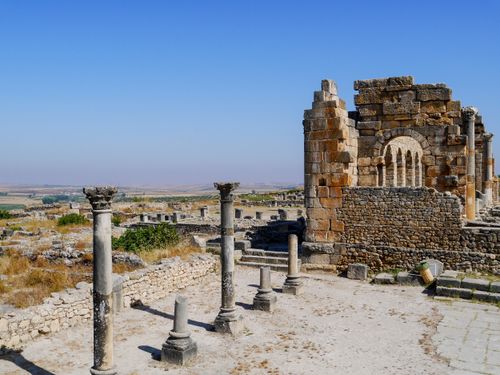
Thirty kilometres north of Meknes, Volubilis stands as the spectacular Roman provincial capital of Mauretania Tingitana — a UNESCO World Heritage Site of in-situ mosaics, temples and triumphal arches.
Set on a fertile plateau **30 kilometres north of Meknes**, **Volubilis** is the largest and best-preserved Roman archaeological site in Morocco — and one of the most evocative ancient cities of North Africa.
**Berber Origins, Roman Capital:**
Founded as a Berber-Punic settlement in the **3rd century BC**, Volubilis became the southwestern capital of the Roman province of **Mauretania Tingitana** under emperor **Augustus** in the early 1st century AD. Olive oil, grain and wild animals were exported from here to Rome itself.
**Mosaics in the Open Air:**
What strikes visitors most are the **in-situ mosaics** that still cover the floors of patrician houses: the **House of Orpheus**, the **House of Venus**, the **Bath of Diana** and the **Labors of Hercules**, all preserved in remarkable detail under the Moroccan sun.
**Triumphal Arch and Capitol:**
The city is dominated by the **Triumphal Arch of Caracalla**, built in **217 AD** in honour of the emperor and his mother Julia Domna, and by the **Capitoline Temple** dedicated to Jupiter, Juno and Minerva. The basilica, the forum and the long colonnaded **Decumanus Maximus** complete the urban landscape.
**Beyond Rome:**
After Rome's withdrawal in the late 3rd century, Volubilis was not abandoned. It survived as a small **Latin- and Berber-speaking town** well into the early Islamic era and is associated with the arrival of **Idriss I**, founder of Morocco's first Islamic dynasty, in the late 8th century.
**UNESCO World Heritage (1997):**
Volubilis was inscribed on the **UNESCO World Heritage List in 1997** for its outstanding witness to the diffusion of Roman civilisation at the edge of the empire.
**A Living Memory:**
Today, walking among Volubilis's olive trees, Roman columns and storks' nests perched on capitals, visitors experience one of the most vivid encounters with the Mediterranean past anywhere in Morocco — a city where Berber, Punic, Roman and Islamic histories meet on a single hillside.