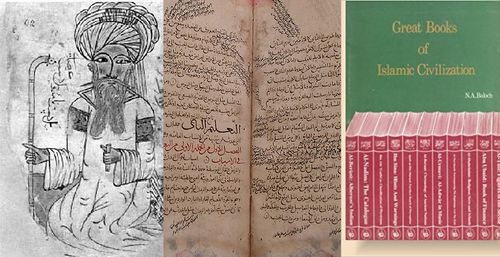
Written in 12th-century Marrakech, Ibn Tufail's 'Hayy ibn Yaqdhan' is widely regarded as the first philosophical novel — and quietly shaped the Enlightenment in Europe.
**Abu Bakr Muhammad ibn Tufail** (Latinised as **Abubacer**) was a 12th-century Andalusian-Moroccan polymath: physician, astronomer, philosopher and poet. Court physician to the **Almohad caliph Abu Yaqub Yusuf** in **Marrakech**, he stands as one of the great intellectual figures of the medieval Islamic world.
**A Philosophical Novel from Marrakech:**
Around **1160**, in Marrakech, Ibn Tufail composed his masterpiece: **"Hayy ibn Yaqdhan"** ("Alive, Son of Awake"). It is widely regarded as the **first philosophical novel** in world literature.
**The Story of a Self-Taught Mind:**
The book tells the story of **Hayy**, a child raised alone on a deserted island, with no parents, no language and no community. Through observation, experience and reasoning, Hayy gradually discovers the structure of nature, the existence of the soul and ultimately the existence of God — entirely **without revelation, scripture or teacher**.
**Reason and Revelation:**
In doing so, Ibn Tufail offers a thought experiment on the relationship between **natural reason and religious revelation**, arguing that an unaided human mind can reach the deepest truths — a daring claim for its time.
**A Latin Bestseller (1671):**
Translated into Latin in **1671** by Edward Pococke as **"Philosophus Autodidactus"**, then into English, Dutch and German, the book became one of the most widely read Arabic works in early-modern Europe. It influenced **John Locke** (notably the *tabula rasa*), **Spinoza**, the **Quakers**, and is often cited as a major source of inspiration for **Daniel Defoe's "Robinson Crusoe" (1719)**.
**Tutor of Averroes:**
Ibn Tufail was also the man who introduced **Ibn Rushd (Averroes)** to the Almohad court and encouraged him to write his famous commentaries on Aristotle. Through Hayy and through Averroes, the wisdom of Marrakech reshaped both the Islamic world and the European Enlightenment.