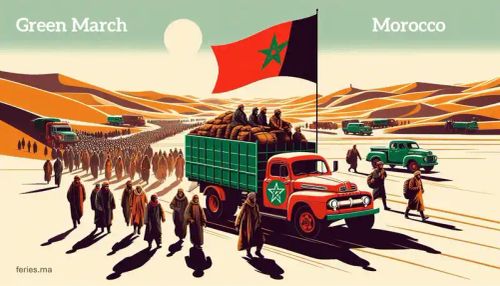
On November 6, 1975, around 350,000 unarmed Moroccan civilians peacefully walked into the Spanish Sahara, carrying the Quran and Moroccan flags — a defining moment of modern Moroccan history.
On **November 6, 1975**, one of the most singular peaceful demonstrations of the 20th century unfolded along Morocco's southern border. Around **350,000 unarmed Moroccan civilians** — men and women from every region of the country — crossed into the then-Spanish Sahara to assert Moroccan sovereignty over the territory. The event is known as the **Green March (Al-Massira Al-Khadra)**.
**The Call of King Hassan II:**
Two weeks earlier, **King Hassan II** had announced the march in a televised speech, calling on Moroccans to walk into the Sahara **"without weapons, with only the Quran in one hand and the Moroccan flag in the other."** The colour green — symbol of Islam and of peace — gave the operation its name.
**350,000 Volunteers from Every Region:**
Volunteers gathered in **Tarfaya**, the southernmost Moroccan town. They were transported by trucks and buses from the four corners of the kingdom and crossed the border on foot in a single day, watched by the world's media.
**The Spanish Withdrawal and the Madrid Accords:**
Coming after a 1975 advisory opinion of the International Court of Justice that recognised historic ties between Morocco and the Sahara, the march brought decisive pressure on a Spain weakened by the imminent death of Franco. On **November 14, 1975**, Spain signed the **Madrid Accords** with Morocco and Mauritania, agreeing to withdraw from the territory.
**A National Holiday:**
November 6 is now an official **national holiday** in Morocco, celebrated each year as the anniversary of a turning point in the kingdom's modern history.
**A Lasting Symbol:**
Beyond its political consequences, the Green March remains a powerful symbol of mass peaceful mobilisation — a moment when an entire nation walked, unarmed, to express what it considered a historic right.