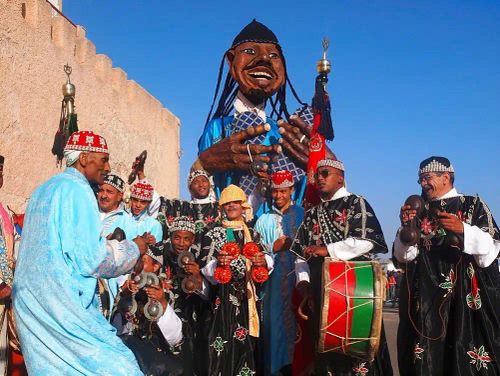
Born from Morocco's sub-Saharan spiritual heritage, Gnawa music is a UNESCO Intangible Cultural Heritage and the soul of one of Africa's biggest world-music festivals in Essaouira.
**Gnawa** is the deep, hypnotic, spiritual music of formerly enslaved sub-Saharan communities who settled in Morocco from the 16th century onwards. Centred on healing rituals known as **lila**, it is one of the most original musical and spiritual traditions of the African continent.
**Instruments and Sound:**
A Gnawa group is built around the **guembri** (a three-stringed bass lute), the metallic clap of the **qraqeb**, and the powerful pulse of the **tbel** drum. Singers — led by a **maâlem** (master) — call and respond in long, trance-inducing pieces dedicated to specific colours and spirits.
**A UNESCO Recognition (2019):**
In **December 2019**, UNESCO inscribed Gnawa on the **Representative List of the Intangible Cultural Heritage of Humanity**, recognising both its musical richness and its role as a living spiritual practice.
**The Essaouira Gnaoua and World Music Festival:**
Founded in **1998** by Neila Tazi, the **Essaouira Gnaoua and World Music Festival** transformed the white-walled Atlantic city into the global capital of Gnawa music. Held each June, it draws **more than 500,000 festival-goers** and is one of the largest free festivals in Africa.
**Global Collaborations:**
The festival is famous for its boundary-crossing **fusion concerts** between Moroccan maâlems and international artists. Over the years, Gnawa masters have shared the stage with **Pharoah Sanders, Randy Weston, Robert Plant, Marcus Miller, Snarky Puppy** and many others, opening Gnawa to jazz, blues, rock and global beats.
**A Living Heritage:**
By marrying ritual depth and contemporary openness, Gnawa has become both a pillar of Moroccan identity and one of the most visible African musical exports — proof that the most local of traditions can speak the most universal language.